The Federal Framework: PCEPA 2014
Canada's current legal framework comes from the Protection of Communities and Exploited Persons Act (PCEPA), which came into force in December 2014. It replaced the previous Criminal Code provisions that the Supreme Court of Canada struck down in Canada (Attorney General) v. Bedford (2013) as unconstitutional — those laws were found to put sex workers in danger by criminalising safety measures.
PCEPA introduced what's often called the Nordic model or end-demand model: it criminalises buying sexual services while not criminalising selling them. The stated goal was to protect sellers while reducing demand.
The key provisions under PCEPA:
- Section 286.1 — Purchasing sexual services: It is a criminal offence to obtain sexual services for consideration (payment). This applies to buyers. First offence: summary conviction or indictment, fine and/or up to five years imprisonment.
- Section 286.2 — Material benefit: Receiving a material benefit derived from another person's sexual services is an offence, with exceptions for legitimate business relationships (platforms, landlords charging market rent, etc.).
- Section 286.3 — Procuring: Recruiting, controlling, or directing another person's sexual services remains a serious criminal offence.
- Section 286.4 — Advertising: Publishing or placing advertisements for sexual services is an offence — this targets platforms and third-party advertisers more than individual providers.
Importantly: selling sexual services is not criminalised under PCEPA. The person providing services faces no criminal exposure under the federal law for the act of selling itself.
What Does This Mean for Escort Services Specifically?
Escort services that sell time and companionship — accompanying someone to an event, providing social company, personal time — are not sexual services under PCEPA and are entirely legal across Canada. This is the basis on which escort directories, agencies, and independent providers openly advertise and operate.
The legal complexity arises where the line between companionship and sexual services is crossed. PCEPA's Section 286.1 targets the purchase of sexual services specifically. The practical implication for clients:
- Booking an escort for companionship through a legitimate platform: legal
- Communicating explicitly about purchasing sexual services in any form: creates criminal exposure under Section 286.1
- How services are described in communication matters legally — this is why professional providers and reputable platforms are careful about language
PCEPA has been challenged constitutionally since 2014. Multiple legal challenges have been filed arguing the law reproduces the same harms the Bedford decision identified. As of 2026 those challenges have not overturned PCEPA at the Supreme Court level, though the legal debate continues.

Provincial Variations: What Changes by Province
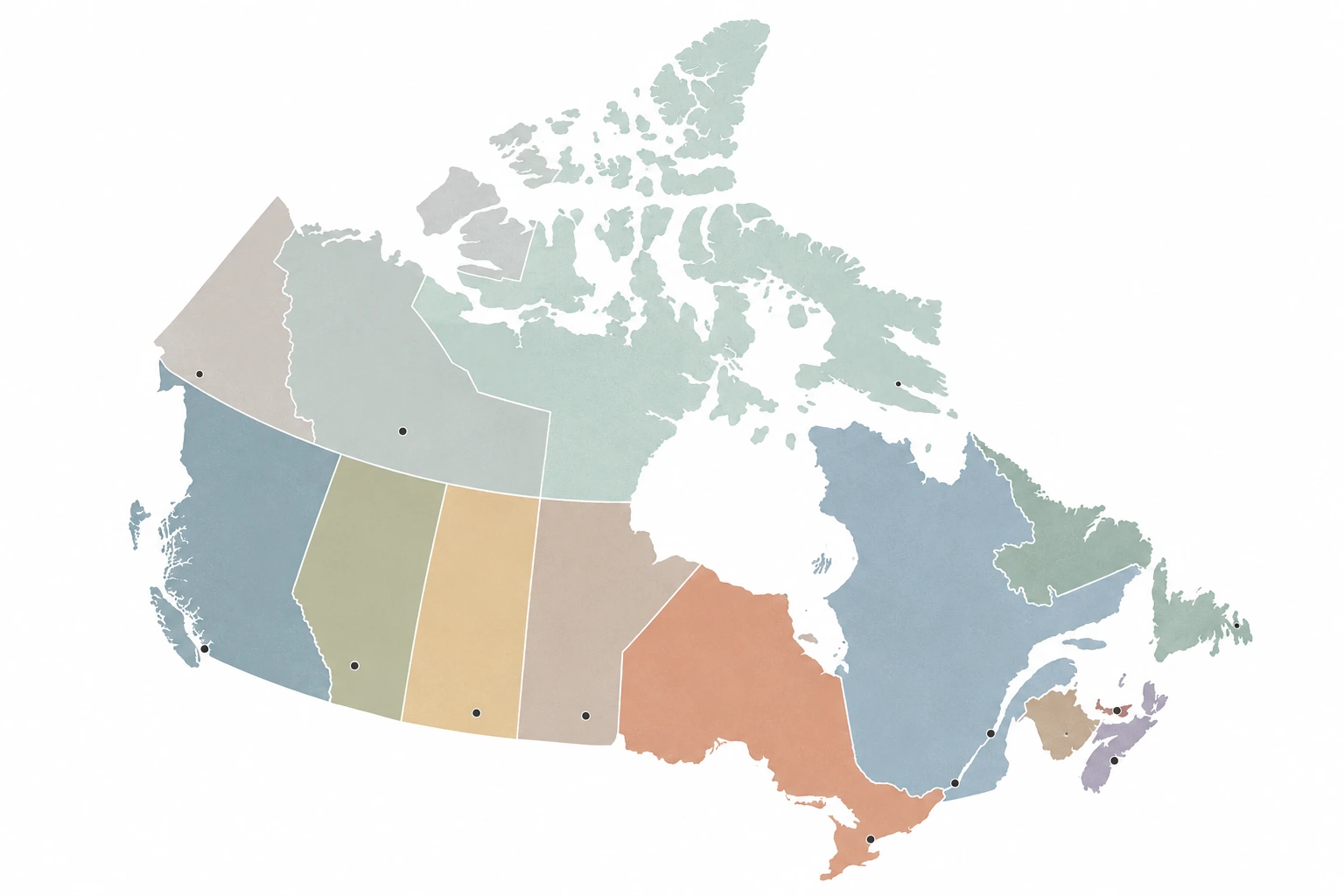
PCEPA is federal law and applies uniformly across all provinces and territories. However, provinces regulate related matters — zoning, licensing, municipal bylaws, and policing priorities — that affect how the market operates on the ground.
Ontario
Ontario has the largest escort market in Canada, centred on Toronto. Provincial and municipal oversight focuses primarily on massage parlours and body-rub establishments, which are licensed and regulated differently from independent escort services.
Toronto's municipal licensing framework requires body-rub parlours to hold specific licences; independent escorts operating from private residences or meeting clients in hotels are not captured by this licensing regime. Ontario's approach to PCEPA enforcement has focused on trafficking and organised operations rather than individual consensual transactions.
Key Ontario context: the Safe Streets and Communities Act and related provincial provisions address soliciting and street-based sex work, with communication for the purpose of selling in a public place near schools or community centres remaining an offence under the Criminal Code.
British Columbia
BC has a complex relationship with PCEPA. Vancouver in particular has historically had more open debate about sex work decriminalisation than most Canadian cities — the Vancouver Area Network of Sex Workers (SWAV) and similar organisations have been active in advocacy and legal challenges since the Bedford case.
BC's provincial government and Vancouver city council have periodically called for decriminalisation but lack the federal authority to override PCEPA. In practice, Vancouver's enforcement has focused on trafficking and exploitation rather than consensual adult transactions. The Independent Investigations Office (IIO) has handled complaints related to police conduct in sex work enforcement.
For escort clients in Vancouver: the framework is the same as Ontario under PCEPA, with BC enforcement priorities similarly focused on organised crime and trafficking rather than individual bookings.
Quebec
Quebec's civil law tradition and distinct cultural context have produced a somewhat different public conversation around sex work, but the legal framework is federal and identical to other provinces. PCEPA applies in Quebec as everywhere else.
Montreal has a large and active escort market. Quebec's municipal licensing framework for adult entertainment venues (strip clubs, etc.) is regulated under the provincial Act Respecting Liquor Permits and municipal bylaws, but independent escort services operating outside licensed venues are governed only by federal PCEPA provisions.
One practical difference in Montreal: the market is bilingual, and some providers work primarily or exclusively in French. Profile listings in Montreal more frequently appear in French or bilingual format than in Toronto or Vancouver.
Alberta
Calgary and Edmonton have established escort markets operating under the same federal PCEPA framework. Alberta's provincial enforcement has traditionally focused on trafficking and street solicitation. Calgary's market has grown significantly in the past decade alongside the city's population growth.
Alberta's Safer Communities and Neighbourhoods Act (SCAN) allows communities to apply for closure of premises used for prostitution-related activity, giving municipalities a tool beyond the Criminal Code — but this targets managed premises, not independent escorts working from private locations.
Manitoba and Saskatchewan
Both provinces operate under PCEPA with no significant provincial additions relevant to independent escort services. Winnipeg has an active market relative to its size; Saskatoon and Regina have smaller but established markets. Enforcement in both provinces has focused primarily on trafficking and street-based soliciting.
Atlantic Provinces
Nova Scotia, New Brunswick, Prince Edward Island, and Newfoundland and Labrador all operate under federal PCEPA. Markets in Halifax (Nova Scotia) are the most active in the region. Enforcement focus in Atlantic Canada has been on trafficking rather than individual adult transactions. Supply on verified platforms in Atlantic Canada is thin compared to major metro centres.
Territories (Yukon, NWT, Nunavut)
Federal law applies. Verified escort directory supply is essentially absent. Local and unverified classified listings exist but fall outside any meaningful accountability framework.
PCEPA in Practice: What Enforcement Actually Looks Like
Understanding the law on paper and understanding how it's enforced are different things. Several patterns have emerged since PCEPA came into force in 2014:
- Enforcement targets operations, not individual transactions. Police resources in major Canadian cities have concentrated on trafficking, coerced sex work, and organised exploitation — not individual consensual adult bookings made through verified platforms.
- Section 286.1 charges against clients are relatively rare. Public data on PCEPA charges since 2014 shows most prosecutions involve trafficking (Section 286.3) or material benefit from exploitation (Section 286.2) rather than client-side purchasing offences.
- Communication remains the practical risk point. How a booking is described in messages, texts, or calls is where Section 286.1 exposure most concretely arises. Professional providers and reputable platforms maintain careful language for this reason.
- Online platforms face Section 286.4 exposure. Platforms that explicitly advertise sexual services face criminal liability. This is why Canadian-facing escort platforms are careful about how services are described — and why Leolist and similar sites have periodic run-ins with enforcement activity.
How This Affects Clients Practically
For clients using verified escort directories for companionship bookings in major Canadian cities, the practical risk profile is low when approached correctly:
- Book through platforms that frame services as companionship and maintain compliant advertising
- Keep communication about what you're booking to the companionship framing — don't explicitly discuss sexual services in any written or recorded format
- Cooperate with client screening — providers screen partly for their own legal protection, and professional screening reduces everyone's risk
- Avoid street-based soliciting or communication in public places near schools or community centres, which carry specific Criminal Code provisions
Is PCEPA Going to Change?
Canada's sex work law has been under ongoing legal and political pressure since PCEPA came into force. Key developments as of 2026:
- Multiple constitutional challenges to PCEPA have been filed in provincial courts arguing the law replicates the harms identified in Bedford. None have succeeded at the Supreme Court level to date.
- Federal political parties hold different positions: the NDP and Greens have endorsed decriminalisation; the Liberals have indicated openness to review; the Conservatives have supported maintaining PCEPA.
- Sex worker-led organisations (Stella in Montreal, SWAV in Vancouver, SPOC nationally) continue advocating for full decriminalisation based on the New Zealand model.
- No legislative change to PCEPA is imminent as of mid-2026, though the political conversation is more active than at any point since 2014.
Frequently Asked Questions
Is it illegal to hire an escort in Canada?
Under PCEPA (2014), purchasing sexual services is a criminal offence in Canada. Hiring an escort for companionship — time and company — is a separate legal category and is not captured by PCEPA's sexual services provisions. The distinction turns on what is actually being purchased and how it is communicated.
Is escorting legal in Ontario?
Selling escort companionship services is not criminalised under PCEPA. Ontario has no provincial law that additionally criminalises independent escort services. Toronto and Ontario's enforcement focus has been on trafficking and organised exploitation, not individual consensual adult bookings.
Is sex work legal in British Columbia?
Selling sexual services is not criminalised under PCEPA. Buying is. BC has not decriminalised sex work at the provincial level despite significant advocacy from Vancouver-based organisations. Federal PCEPA applies in BC as in all provinces.
What is PCEPA?
The Protection of Communities and Exploited Persons Act, in force since December 2014. It introduced the Nordic model in Canada: criminalising the purchase of sexual services while not criminalising the sale. It replaced Criminal Code provisions struck down by the Supreme Court in the 2013 Bedford decision.
Can escort platforms operate legally in Canada?
Platforms that advertise sexual services face exposure under PCEPA Section 286.4. Platforms operating as directories for companionship and escort services — framed and described as such — operate in a different legal position. Verified platforms with compliant advertising language and no explicit sexual service advertising have operated in Canada since before PCEPA without successful prosecution.
Is the law the same across all Canadian provinces?
PCEPA is federal law and applies uniformly across all provinces and territories. Provincial variations affect related matters — municipal licensing, zoning, policing priorities — but the core legal framework is identical from British Columbia to Newfoundland.
Conclusion
Canada's escort law is more nuanced than either "it's all legal" or "it's all illegal." PCEPA criminalises purchasing sexual services while leaving the sale of companionship and escort services in a distinct legal category. Enforcement in major Canadian cities has focused on trafficking and organised exploitation rather than individual consensual adult bookings made through legitimate platforms.
Understanding the framework — and working within it by using verified directories, keeping communication appropriate, and cooperating with provider screening — is how clients navigate the Canadian market responsibly. Browse verified escorts across Toronto, Vancouver, and other Canadian cities on TrystHub — a platform built for compliance with Canada's legal context.
 James Whitaker