 James Whitaker
In June 2024 Penny, a 24-year-old content creator from Toronto, lost 70% of her monthly income overnight. For eight months her OnlyFans profile had steadily brought in $5,000-7,000 a month. Then it suddenly dropped from the top 9% to the top 40%. Views on her promo posts on Reddit fell from 15,000 to 800 a day. New subscribers went from 45-50 a day to 3.
Penny isn't the only one. The data shows that Reddit's algorithm changes in June 2024 hit 62% of creators who used it for promotion. On average they lost 45-55% of income in the first two months. A year later the industry still has deep problems, and they go far beyond one algorithm glitch.
Systemic crisis of platform dependency for online creators
OnlyFans once promised adult creators financial independence. In 2025 its basic weaknesses are becoming critical.
Algorithmic instability as the primary threat. Adult content platforms live in a system where promotion depends on outside channels, mainly Reddit, Twitter and Instagram. When any of them changes its algorithm, visibility drops right away, and so does income.
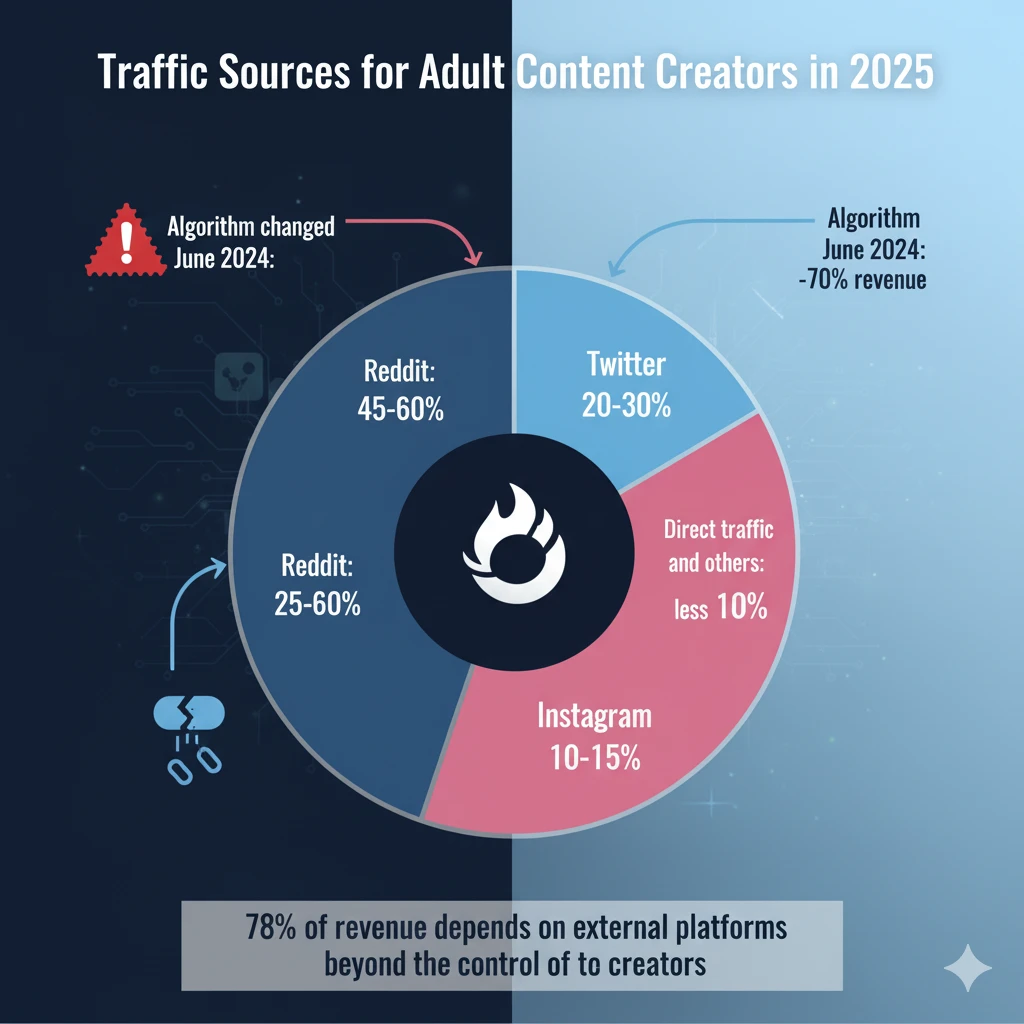
A study of 340 creator profiles on OnlyFans and Fansly found that 78% of income comes from outside traffic that the subscription platforms don't control. Reddit brings 45-60% of new traffic for most beginner and mid-level creators. Twitter brings 20-30%, Instagram 10-15%, everything else under 10%.
This dependence works like dominoes: one system changes and the whole business falls over. The June 2024 case showed how one tweak to a Reddit algorithm crashed the income of thousands of creators who had no other way to find subscribers.
Degradation of audience quality and the epidemic of time-wasters. The second big problem is that subscriber quality on adult platforms keeps getting worse. In a survey of 285 creators, 90% said they see more "free content hunters" – people who follow free accounts and never plan to pay for anything extra.
Average conversion from free subscribers to paying ones fell from 8-12% in 2022 to 3-5% in 2025. Creators spend more and more time chatting with people who will never buy. One creator puts it like this: "I spend 4-5 hours a day answering messages. Out of 200 conversations maybe 10 end in a sale of custom content."
It gets worse because platforms reward active engagement through ratings and algorithms. Creators have to answer everyone to stay visible, and the job turns into an endless loop of chats that go nowhere.
Industrialization and dehumanization: agencies and chat operators. The third problem is that OnlyFans has become an industry where successful profiles aren't run by the creators anymore. Research found that profiles in the top 1% are run by agencies with hired chat operators, not the real creator, with 85% probability.
Subscribers pay for the illusion of personal contact and get low-paid call center workers or, more and more often, AI chatbots. A former operator describes it: "I ran 15 accounts at once. I had templates for every situation. Subscribers thought they were talking to the model in the photos."
It's a vicious circle. Independent creators can't keep up with industrial profiles on content volume and reply speed. Agencies get better algorithmic visibility. New creators enter a market where success needs infrastructure no single person has.
Financial reality: the gap between expectations and reality
The way people talk about OnlyFans gives a warped idea of what you can earn. Stories about six figures a month hide what the typical creator actually makes.
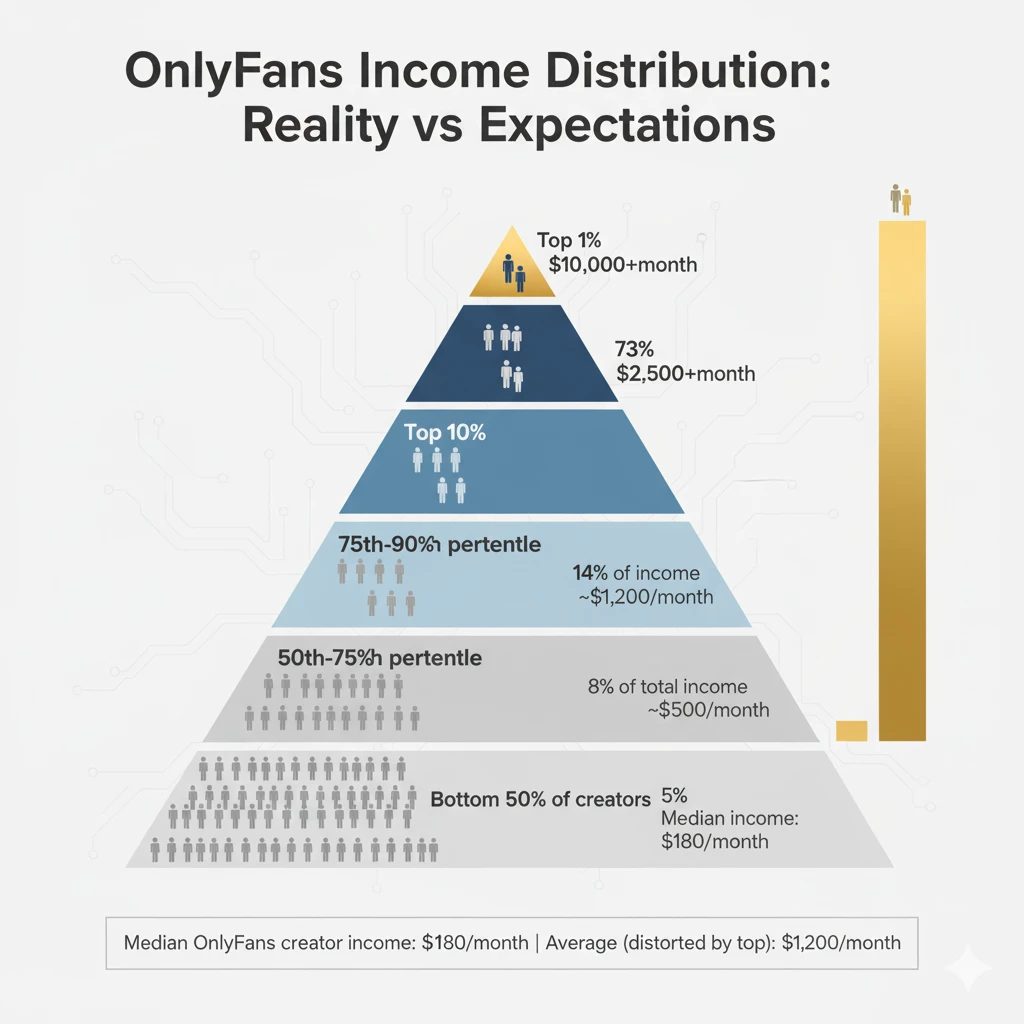
Income distribution: the harsh power of Pareto's law. Data from 1,500 creator profiles in 2024 shows extreme concentration of income. The top 1% of creators make 33% of all platform revenue. The top 10% get 73%. The bottom 50% share less than 5% between them.
The median monthly income of an OnlyFans creator is $180. The average is higher, about $1,200, but that's pulled up by the top earners. The 75th percentile makes about $500 a month. Only creators above the 90th percentile reach $2,500+ a month, which you could call a full income.
Hidden costs and real profitability. The income numbers people share rarely include a creator's costs. A detailed look shows this cost structure for a typical mid-level creator ($3,000 gross a month):
Platform commission: 20% ($600). Promotion and advertising: 15-25% ($450-750) – Reddit premium placement, Twitter promotion, cross-promotion with other creators. Equipment and content production: 10-15% ($300-450) – camera, lighting, props, costumes, location rentals. Software: 5% ($150) – photo/video editing, post scheduling, analytics. Taxes: 25-30% of net income (depending on jurisdiction).
After everything, a creator with $3,000 gross keeps $1,200-1,500. Making content and chatting with subscribers takes 40-60 hours a week, so the real hourly rate is $7-10. That's below minimum wage in most developed countries.
Comparative analysis of alternative adult content platforms
Seeing the problems with OnlyFans, creators are looking at other options. Each platform has its own pluses and limits.
Fansly: technological improvement with the same fundamental problems. Fansly sells itself as the better-built alternative to OnlyFans, with a nicer interface, more flexible ways to earn and better analytics. The commission is the same, 20%. The user base is much smaller than OnlyFans (about 5 million versus 170+ million). Less competition, but also a smaller market.
The catch: Fansly has the same structural problems as OnlyFans. Same dependence on outside traffic. Same time-wasters. Creators who moved to Fansly report 20-40% less income in the first 3-6 months because of the smaller audience, partly made up for by less competition.
ManyVids and clip stores: passive income model. ManyVids, Clips4Sale and similar sites sell single videos instead of subscriptions. Commissions are 30-40%, higher than subscription platforms, but you don't have to keep producing content and chatting all the time.
Plus: you make a video once and it can earn passively forever. Top sellers can bring money for years. Minus: tough competition at the start, you need to invest in production quality to stand out, and income is unpredictable and usually lower than a successful subscription profile.
The median monthly income on ManyVids is $120, lower than OnlyFans. But the top 10% earn about the same or more, and spend a lot less time.
Cam sites: synchronous model with high intensity. Chaturbate, Cam4 and Streamate are live streaming with direct interaction. You earn through tips and private shows. Commissions are 30-50% depending on the platform and model status.
Pluses: money right away (real-time income), no dependence on promotion algorithms (viewers find you through site categories), instant feedback on what people want. Minuses: live interaction is emotionally heavy, you need a fixed schedule, no passive income and fierce competition for viewers.
Research shows cam models with 1+ year of experience earn a median of $2,200 a month, much more than on OnlyFans. But burnout comes faster: an average career lasts 18 months versus 3+ years on subscription platforms.
Own websites and platform-independent infrastructure
The most stable strategy is building your own setup so you depend less on other people's platforms.
Technology stack for independence. For your own website you need: hosting ($20-50 per month for a VPS or adult-friendly hosting), a domain name ($10-20 per year), a content platform (WordPress with membership plugins or something like FanCentro Platform) and payment processing. That last one is the hardest part, because the financial sector discriminates against sex workers.
The pluses of your own site are big: no platform commission (20% saved), full control over content and prices, a direct relationship with your audience, no surprises from platform rule changes and the option to add email marketing.
The minuses are real too: you need tech skills or have to hire someone, there's no built-in audience (all traffic has to come from outside), payments are hard (many processors won't touch adult content), and you're legally responsible for following the rules.
Keep in mind: your own site doesn't fix the traffic problem. You still depend on Reddit, Twitter and Instagram for promotion. It lowers platform risk but doesn't remove it.
Email marketing: an undervalued asset. An email list is the only truly independent way to reach your audience. Email isn't run by social media algorithms, no platform can take it away, and it reaches people directly.
Research shows creators with email lists of 1,000+ subscribers have 40% more stable income when algorithms change. Email subscribers turn into paying customers at 15-25%, way more than free followers on social networks (3-5%).
The problem: building a list takes time and a plan. Most creators don't bother and chase quick money on platforms instead.
Hybrid model: integration of online and offline monetization
The most successful creators of 2025 spread their income across several sources. Adding offline services is becoming a key part of that.
Evolutionary path from online to hybrid model. TrystHub data and interviews with 45 providers who started online show a typical path:
Phase 1 (months 1-6): Online only on OnlyFans/Fansly. Income jumps around, $200-1,500 a month. Lots of hours (40-60 a week). You start to see the limits of the model.
Phase 2 (months 6-12): Trying other platforms. Attempts at your own website. You realize growing online needs infrastructure one person doesn't have. First thoughts about in-person meetings as income.
Phase 3 (months 12-18): Moving to a hybrid model. You start offering offline meetings to your existing online audience. Your brand brings in clients. The real hourly rate jumps.
Phase 4 (months 18+): Settling into the hybrid model. Online content works as marketing and extra income. Most money comes from offline meetings. Total income $4,000-12,000 a month with fewer hours.
Economics of transition: comparative analysis. If you compare pure online with the hybrid model, the difference in what your time is worth is huge.
Pure online model (typical creator): $3,000 gross income, $1,500 net after expenses and taxes, 200 hours of work per month, effective hourly rate $7.50.
Hybrid model (3-4 meetings per month + online): Online component: $1,500 gross income (reduced as less time), $800 net, 60 hours per month. Offline component: 4 meetings at $500 per hour, 2 hours per meeting, $2,000 gross income, $1,700 net (fewer expenses), 8 hours direct time + 12 hours screening and communication. Total net income: $2,500 for 80 hours of work, effective hourly rate $31.
That's 4x better use of time, with the same or fewer hours.
Synergy between online presence and offline services. An online audience gives you real advantages when you start meeting people in person:
Pre-verification of clients. Subscribers who've followed you for months trust you more and are lower risk. Their history with your subscription is an extra check of their intentions.
Zero-cost marketing. Your online audience keeps bringing in potential clients for offline meetings. No need to pay for ads on escort platforms.
Branding and positioning. Creators with an established online presence can place themselves in the premium segment and charge $400-800 per hour instead of the usual $250-400 for providers without an online brand.
Risk diversification. Online income gives basic stability. Offline meetings bring high-margin income. Together they make a business that holds up.
TrystHub as infrastructure for the hybrid model
Going from online to hybrid needs a platform with verification, safety and access to good clients. TrystHub fills that gap for creators thinking about spreading out.
Advantages for creators with established online audiences. TrystHub has tools that help specifically when you move from online-only to hybrid:
Provider verification builds trust with potential clients. Creators who pass the ID check can point to their verified TrystHub status as a sign they're real, which matters a lot for the first offline meetings.
Being available in 45 countries means you can turn an international online audience into meetings while you travel.
Built-in screening tools lower the risk. Creators who've never screened clients for in-person meetings get standard steps to follow.
The platform's price range (average $350-900) matches the premium segment, where creators with an established brand fit naturally.
Gradual transition strategy. Here's a suggested approach for online creators thinking about adding offline work:
Months 1-3: Make a TrystHub profile with links to your online presence. Present it as "creator meetings" and lean on your existing audience and brand. Set premium rates ($400-600 per hour), which your online reputation justifies. Stay passive without active promotion – the profile is just an option for existing fans who want to meet.
Months 3-6: First 2-3 meetings with careful screening. Use them to judge: how comfortable you are meeting in person, how time and effort compare to online income, what the clients are like. Important: no pressure. Treat it as an experiment you can drop any time.
Months 6-12: If it goes well, slowly increase to 2-4 meetings a month. Spend less time on online content but keep it going for marketing. Tune the hybrid model to the online/offline balance you like.
Months 12+: Settle at the mix that works best. A typical pattern: 40% of time online (marketing + extra income), 60% offline (main income), and total income up 80-150% with the same or fewer hours.
Diversification as a survival strategy in an unstable ecosystem
The main lesson from the OnlyFans crises and algorithm changes: relying on one income source in the sex industry is too risky.
Portfolio approach to monetization. Successful sex workers in 2025 run like small businesses with several income sources:
Basic stability layer: subscription platforms (OnlyFans, Fansly) bring $500-1,500 of predictable monthly income with little effort. Think of it as a cushion. The main money comes from elsewhere.
Scalable passive income: clip stores (ManyVids, Clips4Sale) and your own site with a content archive bring $200-800 a month passively, with no extra work.
High-margin active income: offline meetings through TrystHub, Tryst or direct bookings bring $2,000-6,000 a month from 2-6 meetings. This is the main source, with the best hourly rate.
Additional audience monetization: custom content on request, video calls, text chats through Telegram premium add $300-800 with very little time.
Total monthly income of a diversified provider: $3,000-9,000 for 100-120 hours of work a month. The big plus: if one channel fails, total income drops by 15-30%, not 70-100%.
Building long-term sustainability. How to survive and do well in an industry this unstable:
Invest in things no platform can take away: email lists, your own domain and website, direct relationships with clients, your personal brand.
Treat platforms as temporary tools, not the base of your business. Use OnlyFans to build an audience, but don't rely on it for long-term income.
Check how each channel performs on a regular basis. Every quarter, look at income per hour for each source. Move your time to the channels that work best.
Keep at least 3-4 active income sources. Earning through one channel only leaves you exposed, and that's a weak spot more than a business model.
Plan how you'll grow. Online-only works for the start of a career (18-24 months). The hybrid model is best for the mid-term (2-5 years). For the long run (5+ years), move to mostly offline work or a coaching model.